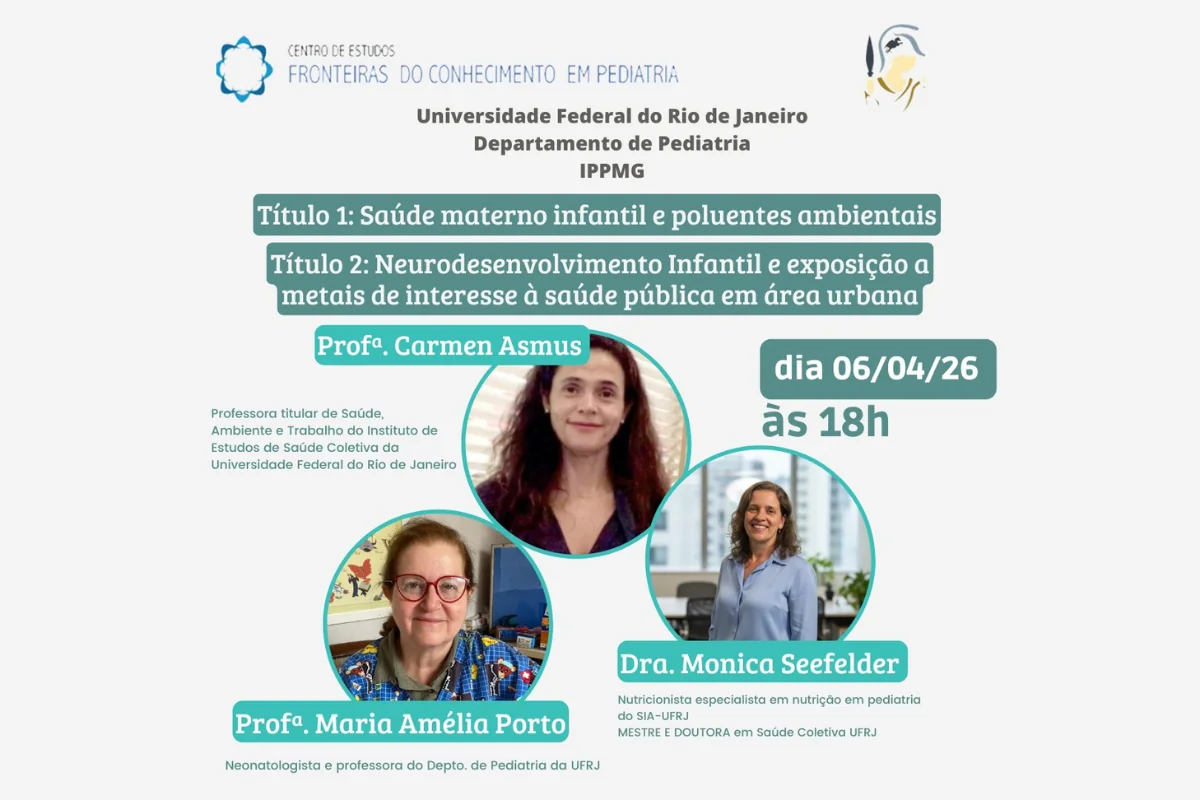
How environmental pollutants affect child development from pregnancy onward was the topic of the meeting
Some of the effects of exposure to environmental pollutants on maternal and child health — already evidenced by studies from the Projeto Infância e Poluentes Ambientais (PIPA) — were at the center of the webinar promoted by the Department of Pediatrics of the Faculdade de Medicina da UFRJ, on April 6, 2026. The meeting brought together researchers Carmen Fróes, PIPA's general coordinator, along with Dr. Mônica Seefelder and Prof. Maria Amélia Porto, with moderation by Prof. Flávia Nardes, as part of the extension course Frontiers of Knowledge.
During the presentation, Carmen Fróes highlighted that exposure to pollutants occurs continuously and is often invisible, requiring a broader view of the environment as a determinant of health. "Every time we look at a baby, at a child, it is extremely important that we also look at the environment in which they live," she stated.
The researchers emphasized that greater child vulnerability is directly related to the biological development process. Systems such as the central nervous system, the immune system, and the endocrine system are still forming, which increases susceptibility to toxic substances present in the air, water, food, and everyday products. The webinar also revisited data already discussed within PIPA, which point to the presence of pollutants in the urban environment and their ability to cross the placenta, reaching the fetus's body still during pregnancy.
In the presentation of the cohort results, analyses on child neurodevelopment were discussed, with emphasis on associations observed between prenatal exposure to metals and changes in developmental domains. The findings indicate the complexity of these relationships, influenced by factors such as exposure level, child's age, and socio-environmental context.
In addition to the empirical results, the meeting addressed the main biological mechanisms involved in pollutant toxicity, such as oxidative stress, hormonal dysregulation, and epigenetic effects — processes that can impact development throughout life.
The activity reinforces the role of science communication as a tool to broaden debate on environmental health and improve maternal and child health practice. The discussion is available on the UFRJ Department of Pediatrics channel on YouTube.